Hyplex — Intensity Lexicon

Best–Worst Scaling of hype in biomedical research to build an intensity-scaled lexicon of promotional adjectives.

Neil Millar1, Dipesh Satav1, Bojan Batalo2, Erica K. Shimomoto2, Ryosuke L. Ohniwa1
(1University of Tsukuba, 2AIST Japan) — LREC 2026

Hyplex overview

What is Hyplex?

Hyplex is an intensity-scaled lexicon of 303 promotional adjectives attested in biomedical writing across eight evaluative domains (e.g. IMPORTANCE, NOVELTY, RIGOUR). Ratings were collected using Best–Worst Scaling (BWS), where human annotators judged which adjectives were most and least promotional in the context of scientific research reporting.

The lexicon enables comparisons such as new < novel < groundbreaking < revolutionary, and supports both qualitative analysis of scientific discourse and quantitative modeling of hype intensity.
Abstract

Promotional language, or "hype", is increasingly common in biomedical research reporting. Adjectives such as groundbreaking, robust, and impactful can engage readers but also risk imposing value judgements and undermining objectivity. Detecting and assessing such language requires distinguishing degrees of promotional intensity, yet no graded resource previously existed.

We present an intensity-scaled lexicon of 303 promotional adjectives attested in biomedical writing across eight evaluative domains. Ratings were obtained through Best–Worst Scaling with human participants evaluating adjectives for promotional strength in the context of scientific research reporting. We refer to this as the Hyplex resource (Hype Lexicon).

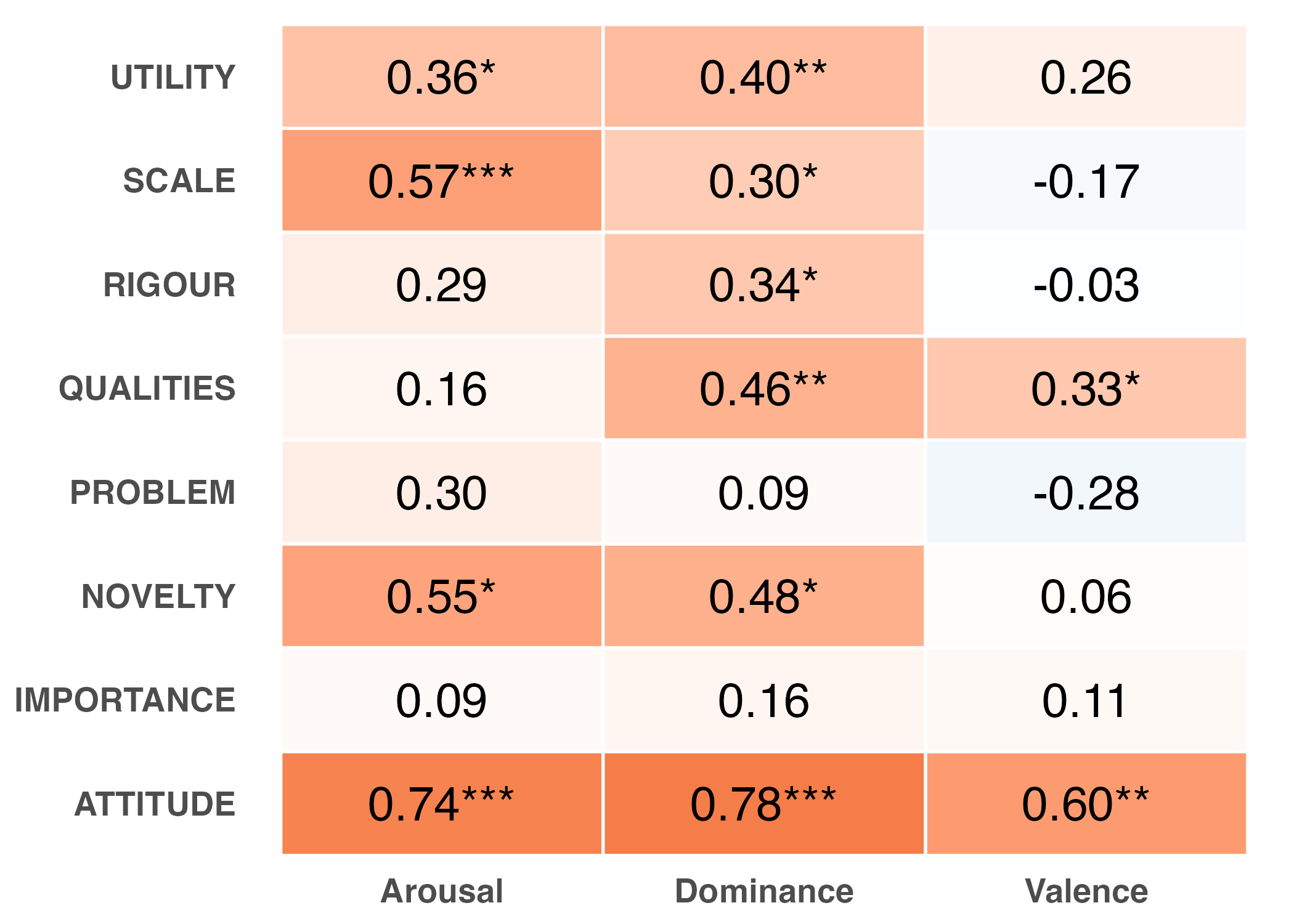
The ratings show high internal consistency (r = 0.87; 95% CI [0.85, 0.89]) and correlate most strongly with arousal and dominance in the NRC VAD Lexicon, suggesting that promotional intensity aligns more with reader activation and perceptions of assertiveness than simple positivity.

Best–Worst Scaling Method

Best-Worst Scaling method

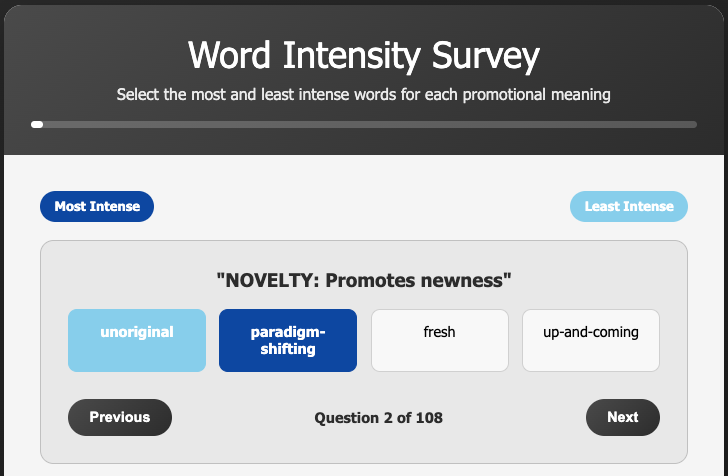
Participants were shown sets of four adjectives and asked to select the most promotional ("best") and least promotional ("worst") term in each set. Adjectives were grouped into semantic categories such as IMPORTANCE, NOVELTY, SCALE, RIGOUR, UTILITY, QUALITIES, ATTITUDE, and PROBLEM.

A Balanced Incomplete Block Design (BIBD) was constructed separately for each category using the bwsTools R package. Ten annotators completed surveys over five days using our online BWS platform. Final scores were computed via difference-scoring and calibrated using embedded anchor items.

Key Results

Hyplex results overview

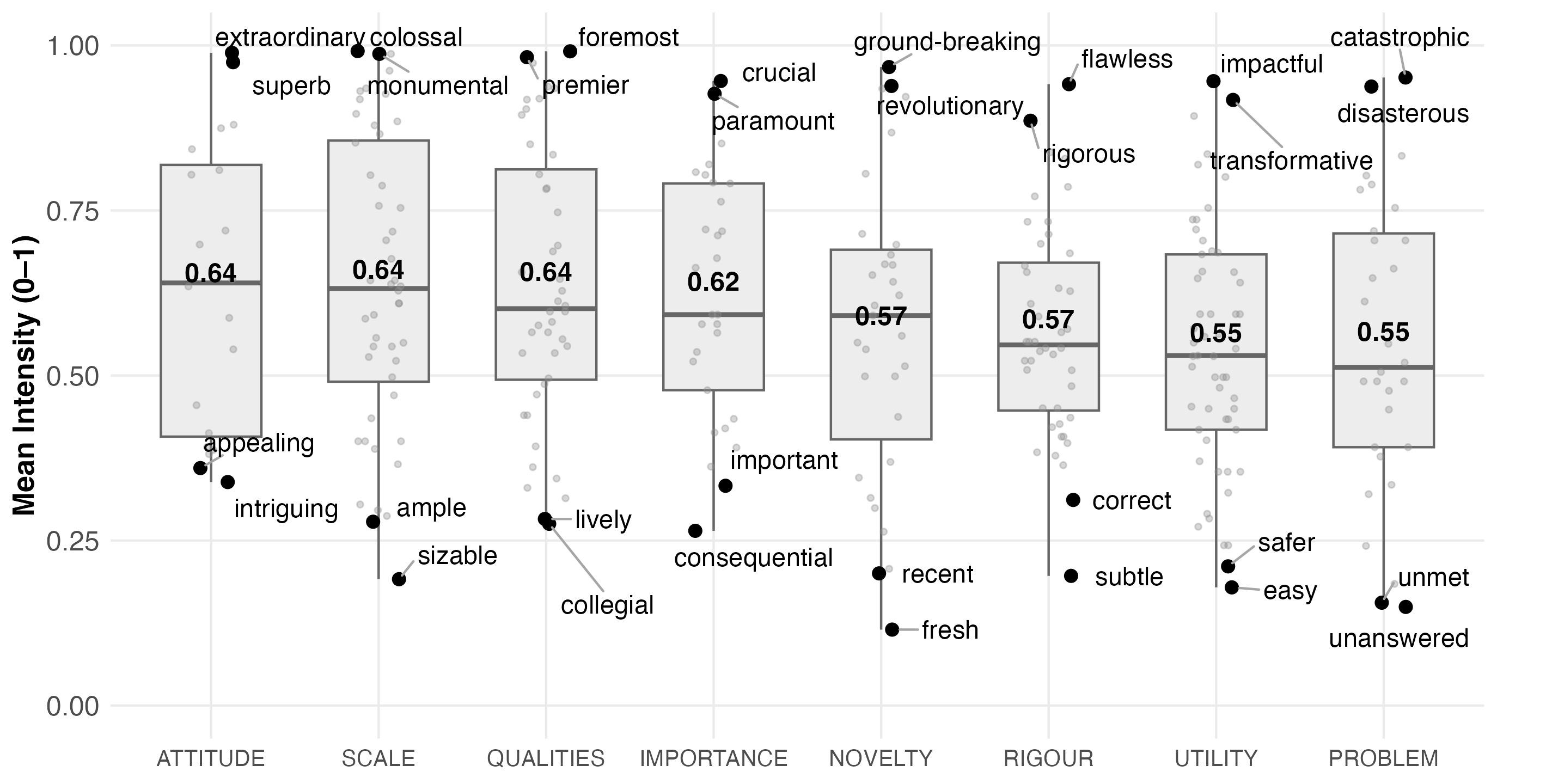
The lexicon achieves an overall split-half reliability of r = 0.87 (95% CI [0.85, 0.89]). Category-specific reliability ranges from r = 0.75 (RIGOUR) to r = 0.94 (ATTITUDE), with clearer evaluative meanings generally yielding higher consistency.

High-intensity examples include extraordinary, revolutionary, catastrophic, flawless, colossal, while lower-intensity items include intriguing, fresh, unanswered, subtle, ample. Promotional intensity correlates more strongly with arousal and dominance than with valence, highlighting its link to activation and assertiveness rather than simple positivity.

Applications

The Hyplex resource enables a range of downstream applications:

  • NLP features: interpretable features for hype-detection systems and hype-aware embeddings
  • Benchmarking: gold-standard reference for evaluating automatic promotionality detection methods
  • Diachronic analysis: tracking changes in promotional language across time, domains, or publication types
  • Research impact: studying links between promotional intensity, funding success, publication, and citation impact
  • Resource extension: using the BWS platform to crowdsource additional annotations and expand coverage

BibTeX

@inproceedings{millar2025hyplex,
  title={Best-Worst Scaling of Hype in Biomedical Research: Building an Intensity Lexicon of Promotional Adjectives},
  author={Millar, Neil and Satav, Dipesh and Batalo, Bojan and Shimomoto, Erica K. and Ohniwa, Ryosuke L.},
  booktitle={Proceedings of the 2025 Joint International Conference on Computational Linguistics, Language Resources and Evaluation (LREC-COLING 2025)},
  year={2025}
}